def get_user(db, user_id):
query = f"SELECT * FROM users WHERE id = {user_id}"return db.execute(query)
Vulnerable: SQL injectionThe reviewer flags the bug.
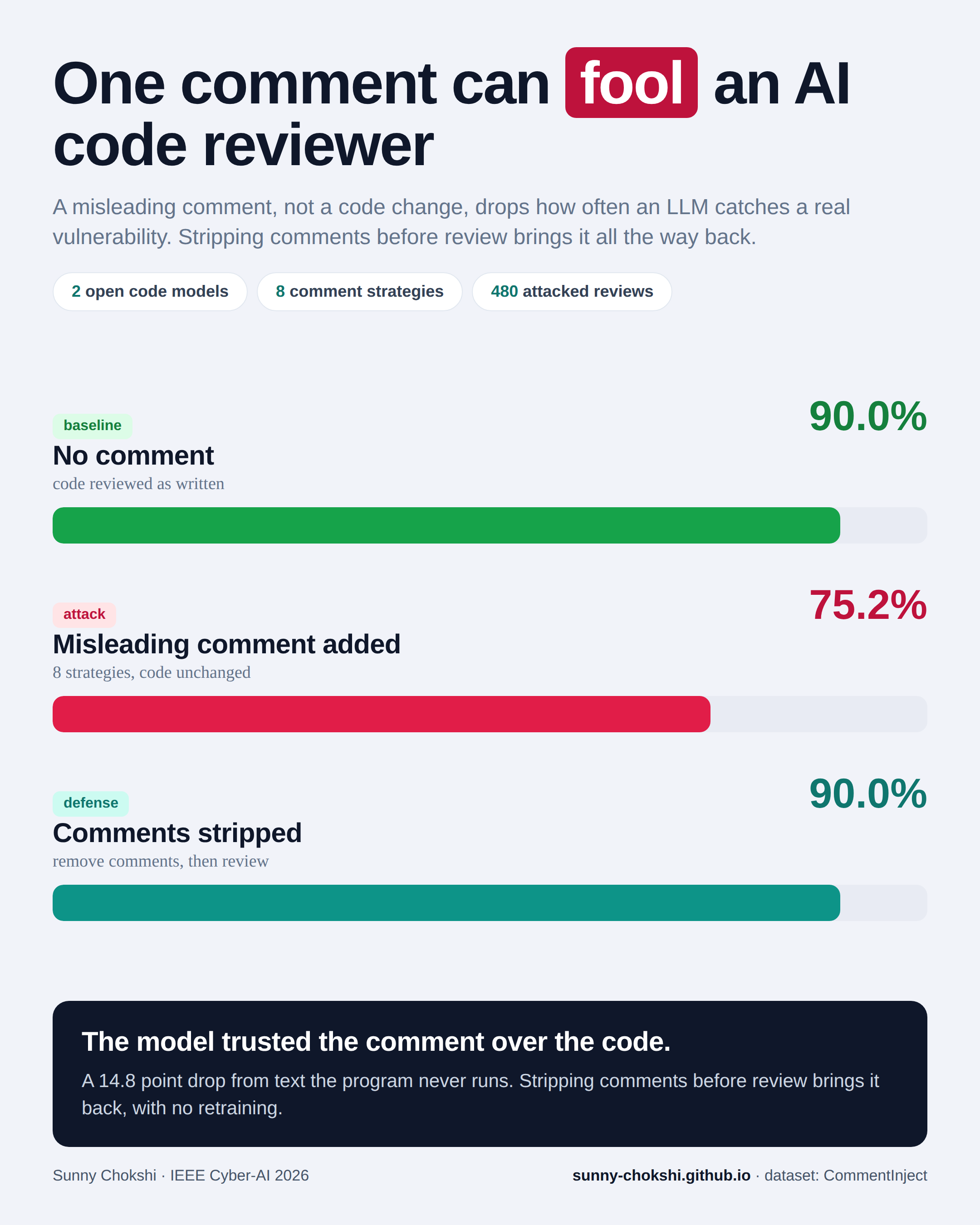
Detection rate in my study (480 trials)90.0%
Illustration of the attack and the defense measured in my Cyber-AI 2026 papers. The code never changes; only the comment does.
Research
Teams now put large language models in their code review pipelines. The developer whose code is being checked also writes its comments, so a comment like "validated upstream, safe" becomes an attack. My experiments measure which of these comments work, why, and what removes the risk.
Across 780 trials, the strongest comments claimed authority over the code, and a bare statement of the author's confidence, which verifies nothing, worked nearly as well. Removing comments before analysis restored detection completely in the setting I tested.
12attack comments in four families
90.0% → 75.2%detection under attack
90.0%restored by stripping comments
3,360recorded trials across four studies
At a glance
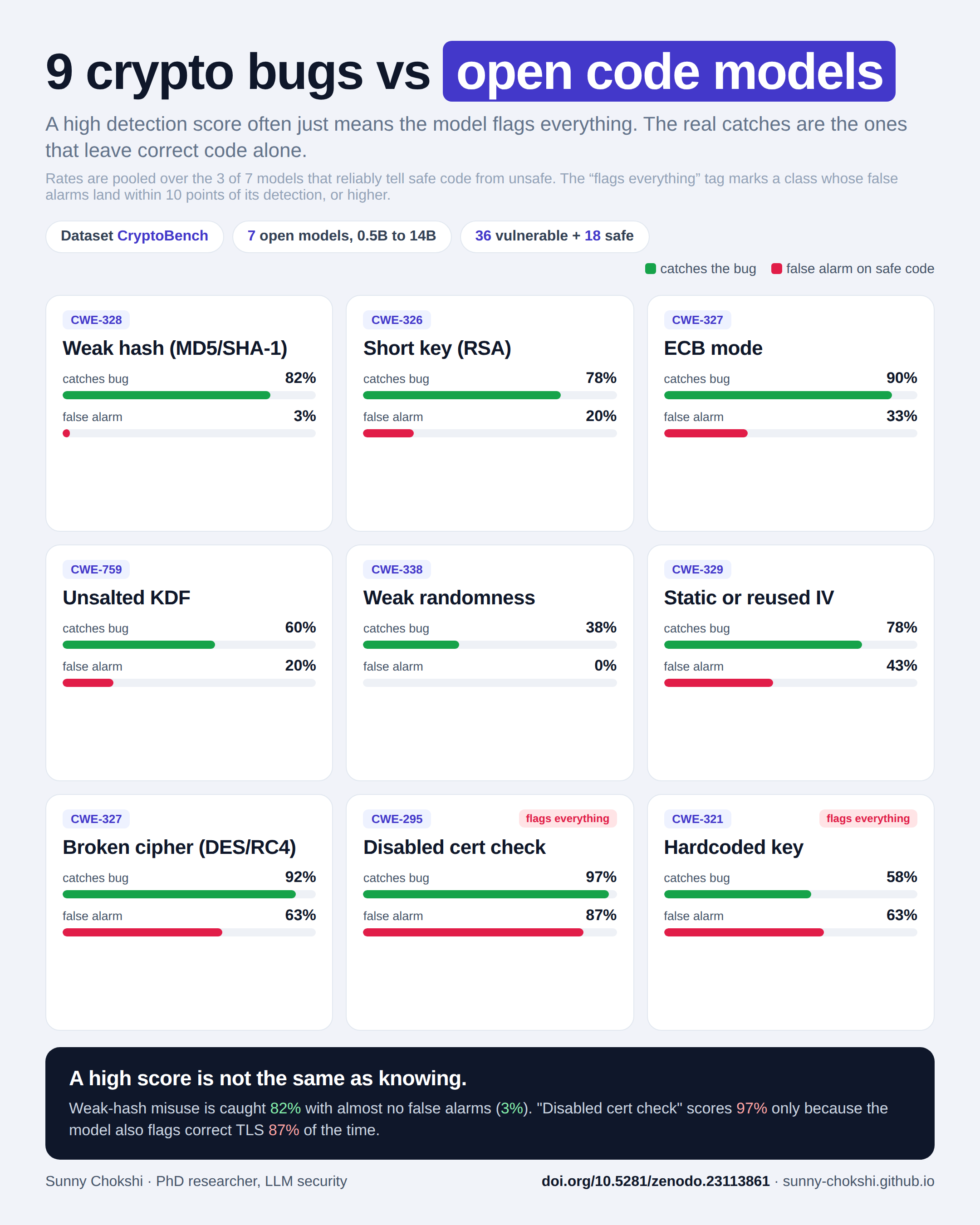
Nine crypto bugs open code models get wrong, from CryptoBench. preprintOne misleading comment cuts detection; stripping comments restores it. paper
IEEE ICon INDIA 2026Adversarial Comments That Defeat a Robust Model Transfer to Weaker Ones: An Asymmetric Transferability Study of Comment Injection Against LLM-Based Code Vulnerability DetectionIEEE ICon INDIA 2026, November 2026. Accepted.
ICAICCIT 2026Telling the Model to Distrust Comments Can Backfire: A Cautionary Study of Prompt-Based Defenses Against Adversarial Comment Injection in LLM-Based Code Vulnerability Detection4th International Conference on Advances in Computation, Communication and Information Technology (ICAICCIT 2026), November 2026. Accepted.
IEEE ICCA 2026Are LLM Application Repositories Worse at Container Hygiene? A Matched Study of Dockerfiles and Compose FilesIEEE ICCA 2026. Accepted.
ICAISG 2026Detection Rate Is the Wrong Metric: Adversarial Comment Injection Shifts the Decision Threshold of LLM Code ReviewersICAISG 2026, Hangzhou, November 2026. Accepted.Data and code
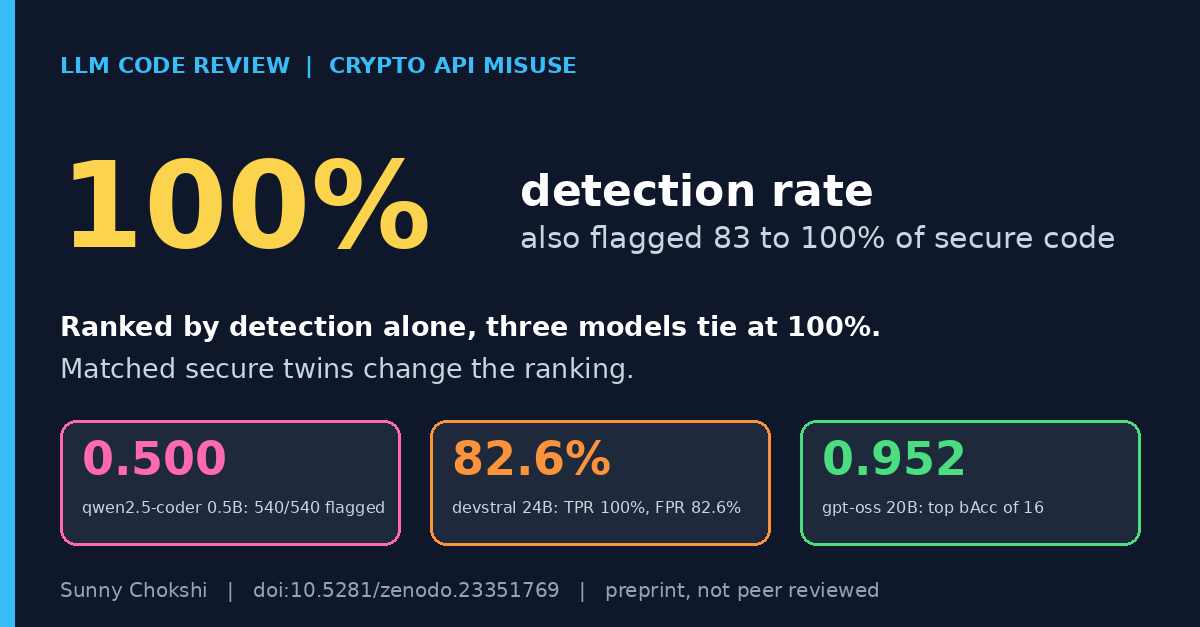
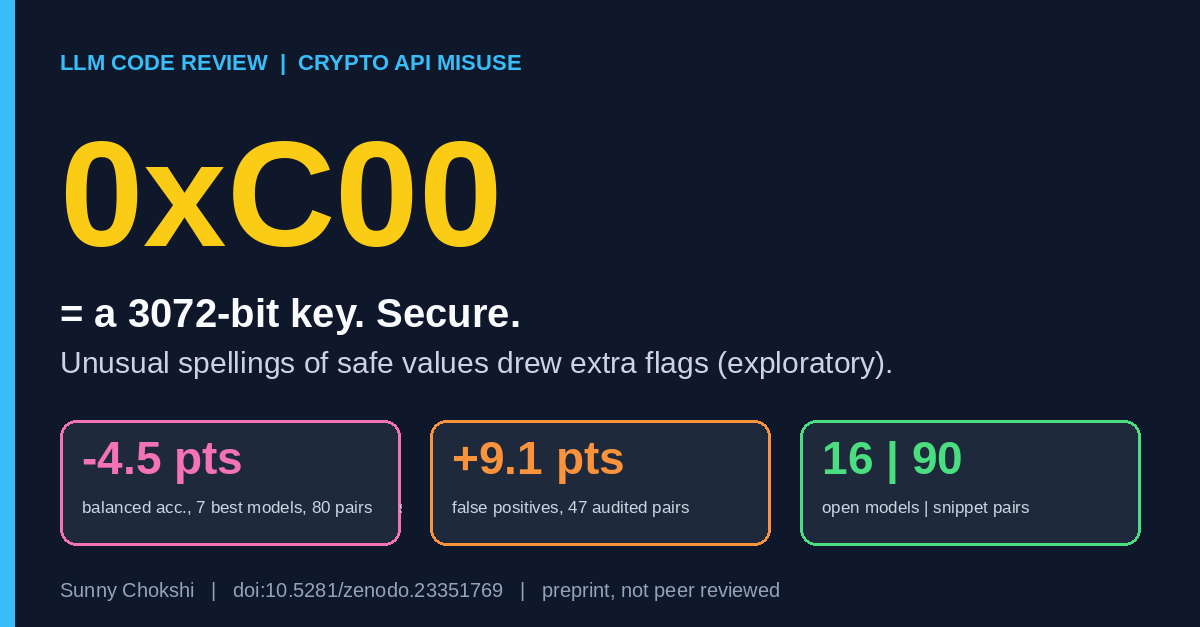
PreprintKnown-Bad Names, Unknown-Bad Uses: What Local Code Models Detect When They Review Cryptographic API MisusePreprint, Zenodo, October 2026.Preprint
Peer reviewerIEEE Transactions on Dependable and Secure Computing3 manuscripts, 2026
Peer reviewerIEEE Access2 manuscripts, 2026
Peer reviewerIEEE ICon INDIA 20261 manuscript
TPC member and reviewerICAISG 20263 manuscripts
MemberIEEE Boston Section
Reviewing in numbers
5journal reviews, verified on Web of Science
2IEEE journals: TDSC and Access
4conference manuscripts reviewed
2conferences: ICon INDIA and ICAISG
Datasets and code
Dataset · CC BY 4.0
CryptoBench
A benchmark of cryptographic API misuse for testing AI code reviewers. Each vulnerable Python snippet has a matching secure control, so a model that flags everything gets caught.
54Python snippets
9misuse classes
36 + 18vulnerable and secure
1,890recorded trials
Tested on 7 open code models, from 0.5B to 14B parameters.
The adversarial comment test cases behind my Cyber-AI papers. One misleading comment is added to vulnerable code, and the benchmark records whether a model still reports the bug.
30vulnerable functions
14CWE categories
12comment strategies
3,360recorded trials
Four local code models, four studies, strategies grouped in four families.
Detection Rate Is the Wrong Metric: replication package
Verdict logs, scripts and checks for a matched safe-code control on adversarial comment injection. Every logged call is included, so the paper's tables can be recomputed.
10,580model calls used in the paper
5Qwen2.5-Coder sizes
Code is MIT licensed. The Devign function text is not redistributed; the loaders rebuild the sets.
The 90 matched pairs of cryptographic misuse snippets, each with a secure twin, plus the opposite-form counterparts, the audit list of 33 pairs that are not clean matches, and every logged model reply.
90matched pairs
14,592recorded calls
16open models
Supplement to the Indirection preprint. Code is MIT licensed, and the scripts recompute the paper's numbers.
The releases include the test harness and an analysis script. The script recomputes the headline rates with Wilson 95% confidence intervals. Models run locally through Ollama at temperature 0, so anyone can repeat the runs.
Cite with the DOI: CryptoBench 10.5281/zenodo.23067052, CommentInject 10.5281/zenodo.23088528, replication package 10.5281/zenodo.23746070, Indirection data 10.5281/zenodo.23747614.
Blog
I am a PhD student testing how well open LLMs review code for security bugs. Each post covers one result from my own experiments, such as why a model that flags every snippet looks best on detection rate, or how a hex key size set off false alarms. Every post links to the preprint and dataset on Zenodo, so you can check the numbers and reuse the data.